
Plant Polymers, Explained: What Your Luminaires Are Really Made Of
Following our webinar on sustainable materials, here's what we covered — including the honest limits of the technology, not just the highlights.
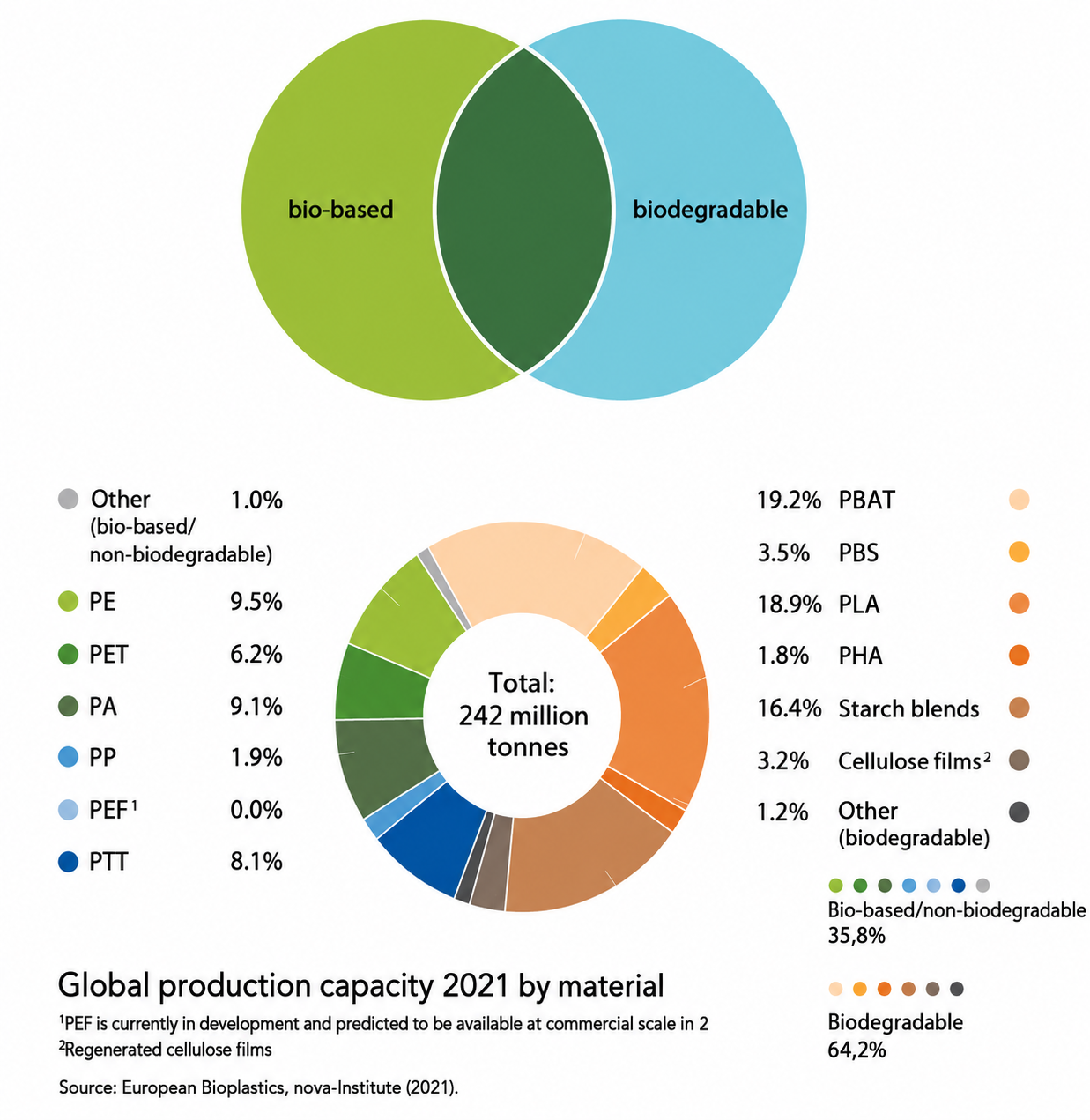
What is a "bio-plastic," really?
By the European Bioplastics definition, a material only needs to be bio-based, biodegradable, or both to be labelled a bioplastic — a low bar that covers a huge range of materials, some genuinely sustainable and some not.
Taken literally, oil itself could be described as "bio based." Many conventional plastics — including PE and PP — can be produced from bio-based feedstocks too, without becoming meaningfully more sustainable in use.
And "biodegradable" comes with its own asterisk: most polymers carrying that label will only break down in industrial composting conditions — not in landfill, and not in the sea.
Why we say "plant polymers" instead
Given how loosely "bioplastic" gets used, we prefer plainer language: plant polymers. It says exactly what the material is — made from plants — with nothing left to interpretation. At LumiAdd, that means two materials specifically:
PLA
Poly Lactic Acid. Breaks down only in industrial composting conditions — not landfill, not marine environments.
PHA
Polyhydroxyalkanoates. Breaks down in any biotope, including landfill and marine environments.
We'd rather be specific and slightly less flattering than vague and impressive. Ultimately, our goal for end-of-life is to re-use or recycle material through our own buy-back scheme, rather than rely on biodegradability alone.

The carbon footprint case
As a raw material, PLA produces 97.5% less CO₂ than aluminium sourced in the Far East, and 92.7% less than aluminium sourced in the EU. It also produces 30–70% less CO₂ than petrochemical polymers.
Sources: Vision 2050 — European Aluminium's Contribution to the EU's Mid-Century Low-Carbon Roadmap (European Aluminium); "Environmental impact of bioplastic use — a review," Heliyon; Life Cycle Impact Assessment of PLA Produced from Sugarcane in Thailand; Greene, J.P., Sustainable Plastics.
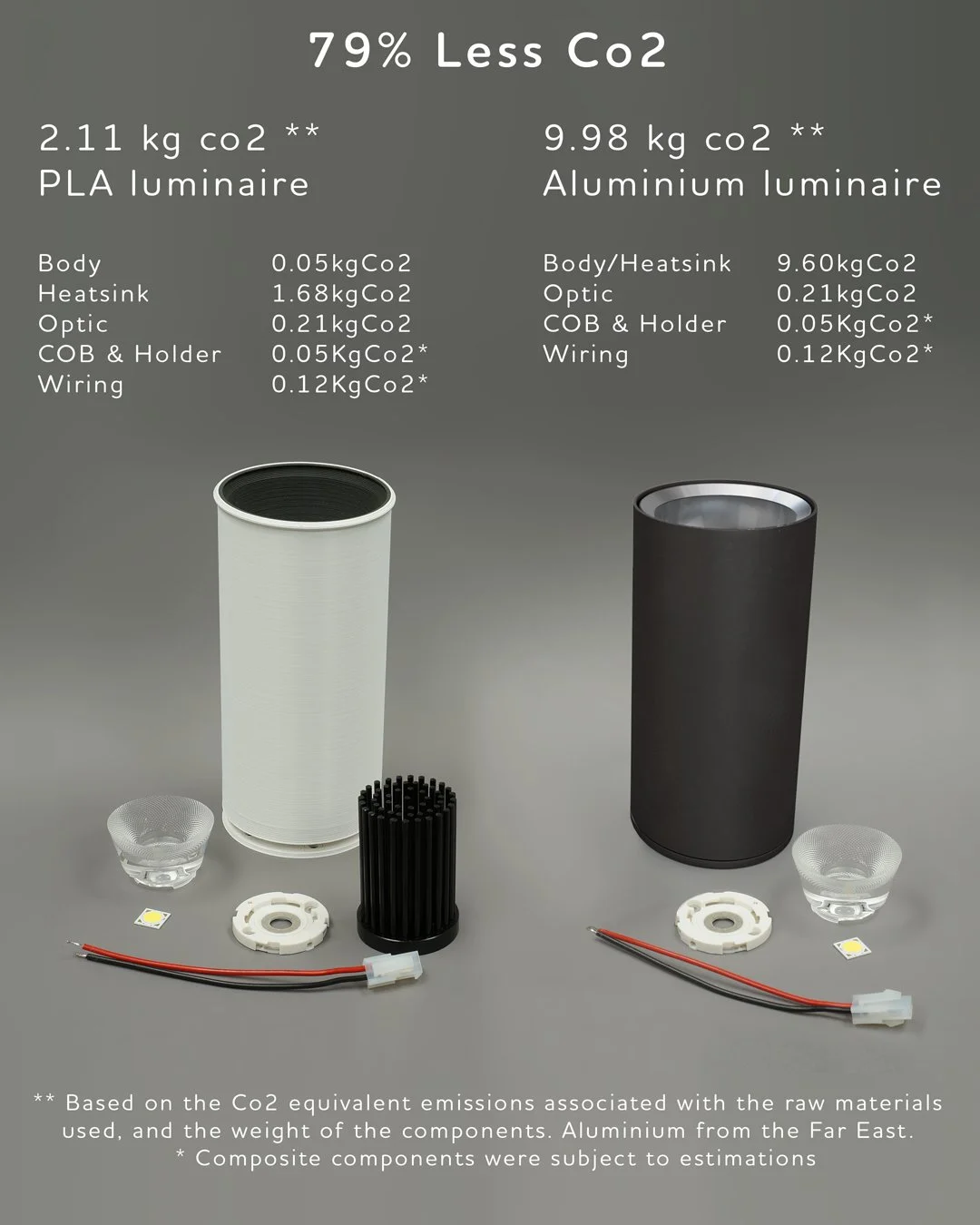
We took this further with our own comparison: a luminaire constructed from aluminium with an integral heatsink, against our equivalent luminaire — 3D printed in PLA with a separate heatsink, all other components identical.
ConstructionCO₂ (raw material, cradle-to-gate)Aluminium, integral heatsink9.98kgPLA, separate heatsink2.11kgSaving79% less CO₂
This comparison only accounts for raw material emissions. Processing aluminium takes considerably more energy than processing PLA, so the real-world saving — once manufacturing and transport are factored in — will be higher still. We'll publish updated figures as our own calculations go into more detail.
Does it stand up to scrutiny?
Yes — but not all PLA is made equal.
PLA isn't as standardised as other polymers. There's a wide range available, with different attributes across flexibility, mechanical strength and heat resistance. Which PLA you use matters enormously.
The specific plant polymer blend LumiAdd uses is robust, with good heat resistance (134 degrees C HDT) — tested extensively, including independent glow-wire testing.
One honest limitation: we wouldn't recommend plant polymers for exterior products. It's a boundary we're upfront about, because credible claims need credible edges and we have no testing data to see how they hold up in exterior environments.